The Six-Minute Soufflé and Other Culinary Delights
by Carol Cutler Clarkson N. Potter 1976
 I picked this up at an AAUW sale (always a good bet for some
cool cookbooks). I was initially drawn in by the design and the title and
thought it would be a quick-cook book with lots of processed ingredients. But
my initial scan showed lots of simple classic French dishes instead along with
some intriguing flavor combinations. Once home, a more thorough reading
revealed an accomplished book whose recipes don't feel dated at all. A little
quick research showed I am not alone in my appreciation; the James Beard
Foundation gave it an award in the Basic category of 1977.
It does have a very 70s layout with tan pages and maroon
titles, but it is attractive and the recipes still seem fresh--perhaps because
of the emphasis on timeless French classics. Cutler lived in France for 12
years and studied at the Cordon Bleu, but she is quick to point out that the
recipes in the books are geared toward the home cook who needs to be practical
with his or her time.
One way the book reflects changing social mores is her
frequent recommendation that a recipe would work well for an
"important" dinner. We no longer entertain bosses or clients in our
homes any more; we impress by going to Nobu or Bouchon or someplace equivalent.
It may be more financially impressive to pick up a whopping restaurant tab, but
it is not as intimate as entertaining at home, perhaps mercifully so. We are no
longer socially required to invite people into our homes who actually mean to
judge us. Back in the day, failing at dinner could mean losing a promotion or a
deal. Now screwing up dinner for friends usually just means calling for a pizza
and opening another bottle of wine. The result is that pulling off a well-cooked
meal for non-friends is now exclusively the purview of the professional, not
the home cook, no matter how accomplished.
 |
| Pale but pretty |
Danish Cauliflower
by Carol Cutler
This is quite good--cool and tangy, a bit like celeriac
remoulade but with a different texture. Cutler has it as a first course, but it
works as a salad or a side dish. The chilling does make a difference, as it
allows the flavors to mellow and permeate the cauliflower.
This is also a little more formal than one of my go-to
lunches of roasted cauliflower with a dipping sauce made from mayo mixed with
either tarragon and tarragon vinegar or with a dash of Taste No. 5 Umami paste.
It's astonishing how much cauli I can eat when dipped in mayo!
1 large head cauliflower
1 tsp salt
1 cup mayonnaise
½ cup plain yogurt
juice ½ lemon
salt and pepper
2 teaspoons chopped parsley
Break the cauliflower into florets and cook in boiling water
with the salt just until tender about 5 minutes. Do not overcook. Drain at
once. Plunge into cold water again and drain very well. I suggest patting dry
with a tea towel.
Mix the mayonnaise, yogurt, mustard, lemon juice, salt and
pepper. Place cauliflower in a deep bowl and pour sauce over, carefully turning
florets over to coat in the sauce. Chill for about 3 hours. When ready to serve
sprinkle with the parsley. I like parsley quite a bit, so I upped the amount to
2 tablespoons.
But what about that Six-Minute Soufflé of the title? Once I
read the technique I had to try it. Cutler's trick is to use cream cheese as a
base instead of a cooked starch. She does not whip the egg whites. All the
ingredients go into a blender and then into the oven. It really is 6 minutes to
mix up--at most.
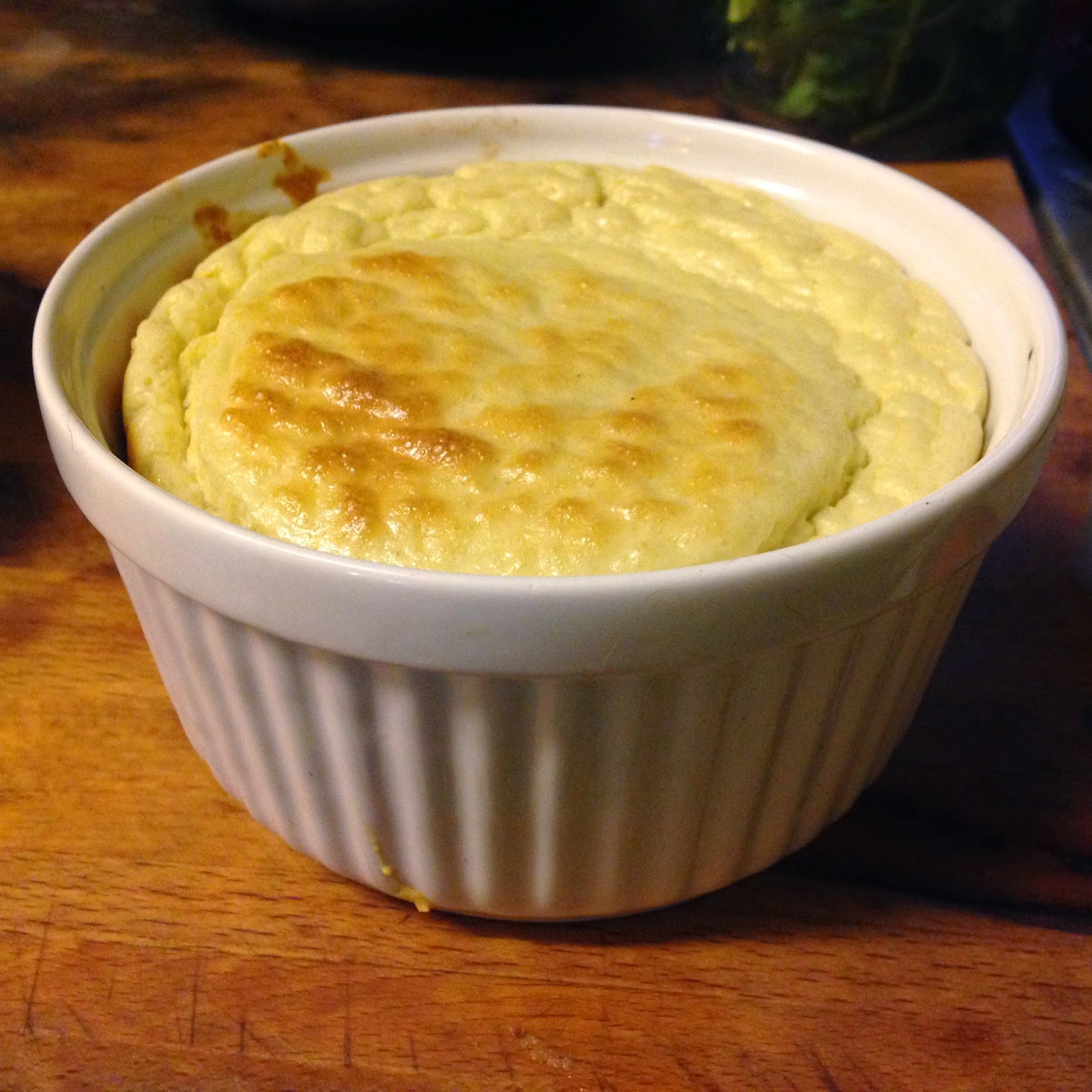 |
| It was a white food kind of day |
The result is a bit denser than a classic soufflé--but I did
cook it well done instead of tremblant,
as that is what I was in the mood for. It rises, but not as dramatically as a
regular soufflé. Therefore, it doesn't collapse very much on cooling and was
very good the next day cold. Then it had the taste and texture reminiscent of
boursin cheese. Hot or cold, this would be good with a salad. I made the blue
cheese base recipe, but Cutler also offers variations that sound good, like
cheddar or ham, and ones that sound questionable like canned salmon and hot
potato--despite my love of the potato I am not sure about it as a soufflé
flavor.
Roquefort Soufflé
By Carol Cutler
6 eggs
½ cup heavy cream
1 tsp Worcestershire sauce
dash Tabasco
¼ tsp pepper
pinch of salt
½ pound Roquefort or blue cheese
11 ounces cream cheese
1 Tbs butter
Put eggs, cream, Worcestershire sauce, Tabasco, pepper,
pinch of salt in a blender. Blend until smooth. With the blender running, break
off pieces of the blue cheese and add to the container. Do the same with the
cream cheese. Once combined, blend at high speed for 5 minutes. Smear a 6-cup
soufflé dish or individual 1 cup soufflé dishes with butter. Pour in the batter
and bake 40 to 45 minutes for the 6-cup soufflé or 15-20 minutes for the
individual molds. The top should be browned and the center should jiggle just a
bit when shaken. If you like a firmer set, cook 5 to 10 minutes longer; the
filling will crack. Serve at once while hot. If it must be held, turn off the
oven and open the door a crack to prevent overbaking.
Notes: I used an indifferent supermarket brand of blue
cheese. It came out cheesy but not super blue. A better cheese would give
better results, I'm sure. I halved the recipe quite successfully and baked it
in two 1 ½ cup ramekins. Cutler adds that the recipe can be prepared and held
in the baking dish at room temp for 1-2 hours before baking or held in the
fridge for longer. Bring up to room temp before baking or add another 5-10
minutes of oven time.
A bonus feature is Cutler's suggested menus for many of the
dishes. I've always enjoyed reading menus, though I never actually recreate
them in full. I remember reading the month-of-menus in my mother's Family
Circle and Woman's Day magazines and being fascinated by the structure and
fussiness of the precise amounts and the insistence of listing simple things
like milk, butter, and rolls. I even liked reading the school cafeteria menus
though I knew from bitter experience that no matter how good a menu sounded on
paper, I was sure to be disappointed!
Cutler places the Danish Cauliflower as a starter for a meal
that includes Boeuf à l'estouffade des mariniers du Rhône (Beef Braised in Piquant Sauce), Baked Gnocchi, and
Tropical Sherbet. The soufflé goes well with Sautéed Soft-shelled Crabs,
Cauliflower Gratin, and Blueberry Clafouti. That sounds like a lovely spring
meal.
 |
| Such joie de vivre! |

